
Kapaʻa Busted Mugshots
Kapaʻa anchors this site's Kauaʻi city map. The April 1, 2020 Census put 11,652 people there, the island's biggest population center. One catch, though. Hawaii has no incorporated cities the Census Bureau recognizes. So "Kapaʻa city" is a fine search phrase, but it names no police jurisdiction. The Kauaʻi Police Department polices the whole island. That means no Kapaʻa PD arrest log, no Kapaʻa jail, and no Kapaʻa-only mugshot roster.
So where do arrests go? They start at KPD Cell Block or Intake and Detention. After court, a KPD entry coded "ISC" can signal a transfer to KCCC, the State DCR jail. Some people post bail. Some get released on recognizance. Some walk out without formal charges, and others move through the courts while the dated arrest record stays on file. The countywide source is the KPD Arrest Log. Its sample PDF lists Residence City, name, arrest date and time, sex, age, charge, and release disposition, but no routine booking photo.
Where Kapaʻa Busted Mugshots Appear
Put official sources first in any Kapaʻa search. Local stories and selected press releases may carry an image now and then, but the county's routine arrest PDF is text-first.
| Source | Photo and Kapaʻa coverage | Custody or record limit |
|---|---|---|
| KPD Arrest Log | Countywide daily PDF; no routine photo in the sample | Dated arrest chronology, not a live roster |
| KPD Kapaʻa releases | Vehicle-break-in and stabbing releases include selective mugshot or booking-photo material | Incident-specific and not complete |
| KPD Records | Request a releasable report or photo using the non-business form | UIPA review, redactions, and no fixed photo fee posted |
| Local news | The Garden Island, Kauaʻi Now, and HNN cover Kapaʻa stories | Editorial archive, not current custody |
| Mugshots.com | Kapaʻa appears under an empty Kauaʻi category | Unofficial and not evidence of no KPD records |
The Kauaʻi County arrest and mugshot hub lays out the whole picture, from roster and records to DCR, court, and federal paths. Guessing at a city-specific commercial URL rarely pays off. The county feed is the safer starting point.
Busted in Kapaʻa: Find the Record
Search by date and agency, not by city name alone. The Residence City field only tells you where a person lives, so it never proves the arrest happened inside Kapaʻa CDP itself.
- Open the KPD Arrest Log and choose the daily PDF for the likely arrest date. Search the name and read every charge row.
- Read the release code. `ISC` points to KCCC after court; `RBL`, `ROR`, `RPI`, `RNC`, and `RPC` describe other reported outcomes or stages.
- Check KPD County press releases for the case name or Kapaʻa incident. A selected photo may be there even though the daily PDF is text-only.
- Request the underlying report, booking record, and any releasable photo from KPD Records if the online sources do not answer the question.
- Search eCourt Kōkua and the Fifth Circuit for the later case and disposition.
Questions about someone in a KPD cellblock go to Cell Block at (808) 241-1632 or Intake and Detention at (808) 241-1637. These are live-stage contacts, not a public searchable roster.
KPD Records for Kapaʻa Busted Arrests
Kauaʻi Police Department Records sits at 3990 Kaʻana Street, Suite 200, Lihue, HI 96766. Call Headquarters at (808) 241-1900. Dispatch, for non-emergencies, is (808) 241-1711, and the Records status line is (808) 241-1929. Per the Records Section, most reports become releasable once investigative work wraps up and the case closes, subject to UIPA review.
Use the KPD non-business form. Include the full name, the incident or arrest date, a report number if you have one, and the request type. Say the request concerns a Kapaʻa arrest. Then list the daily arrest entry, any releasable booking or arrest record, and any releasable booking photograph as separate items. KPD schedules a pickup appointment once the report is ready. No fixed photo fee is listed, so ask about duplication or delivery costs.
KPD Kapaʻa Records Route
Records status: (808) 241-1929
Headquarters: (808) 241-1900
Dispatch/non-emergency: (808) 241-1711
Address: 3990 Kaʻana Street, Suite 200, Lihue, HI 96766
The OIP request guidance covers written UIPA requests, the general 10-business-day response or acknowledgment window, possible extensions, and prepayment. Still, the county route runs through KPD Records. Expect that a record may be redacted or withheld under privacy, juvenile, investigative, or other exceptions.
Kapaʻa Busted Photo Releases
One KPD release about Kapaʻa vehicle break-ins shows how a joint operation can earn a public announcement plus a selective image. It names both KPD and DLNR DOCARE as participants. It also gives case-specific custody or bail detail. That is a far cry from a Kapaʻa photo roster. Follow the source link, check the date, and compare the event against the KPD daily report.
The official release is preserved at the original County vehicle-break-in release.
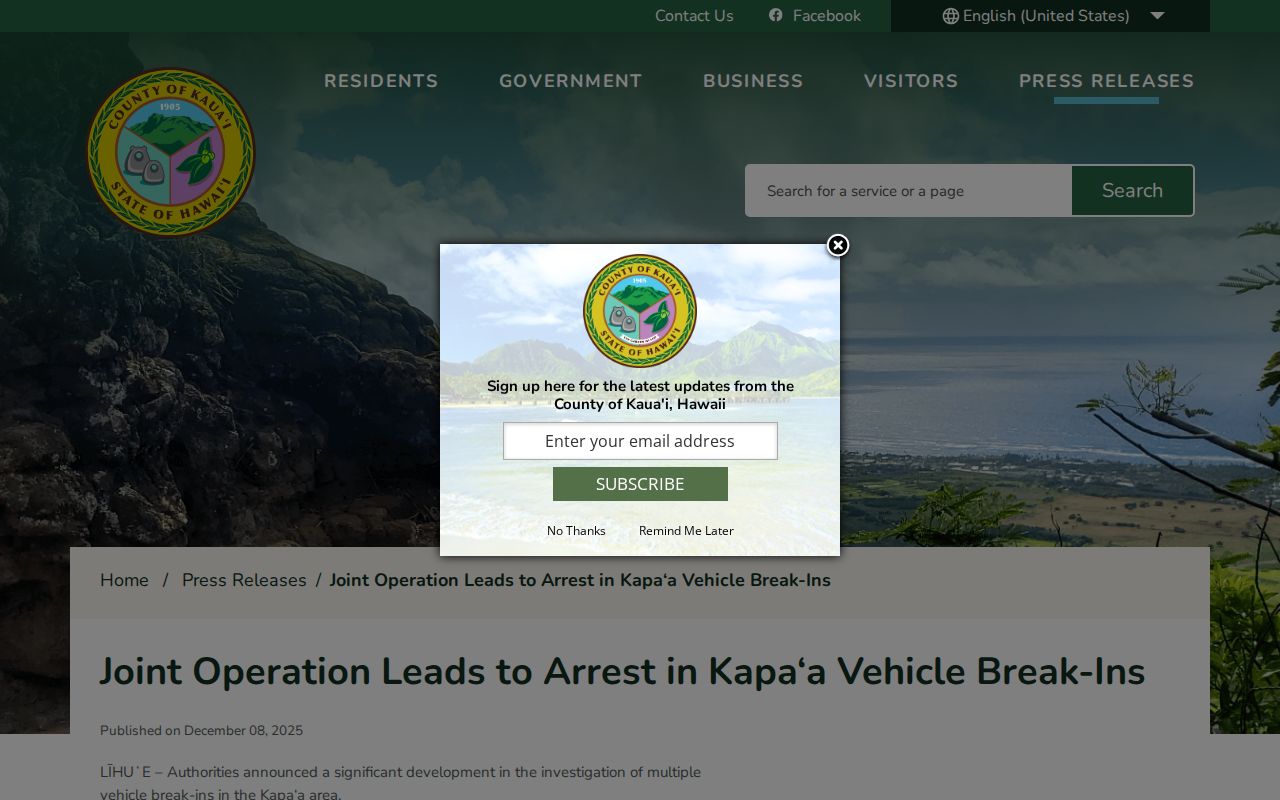
An image like that reflects an official publication choice. It does not mean every Kapaʻa arrest comes with a public photo, or that the person stayed in custody.
A separate Kapaʻa stabbing release includes a mugshot and bail detail. The daily media PDF often leaves that kind of information out. That is why a specific case can demand both the press-release path and a KPD Records request.
The second capture is tied to the official Kapaʻa stabbing release.
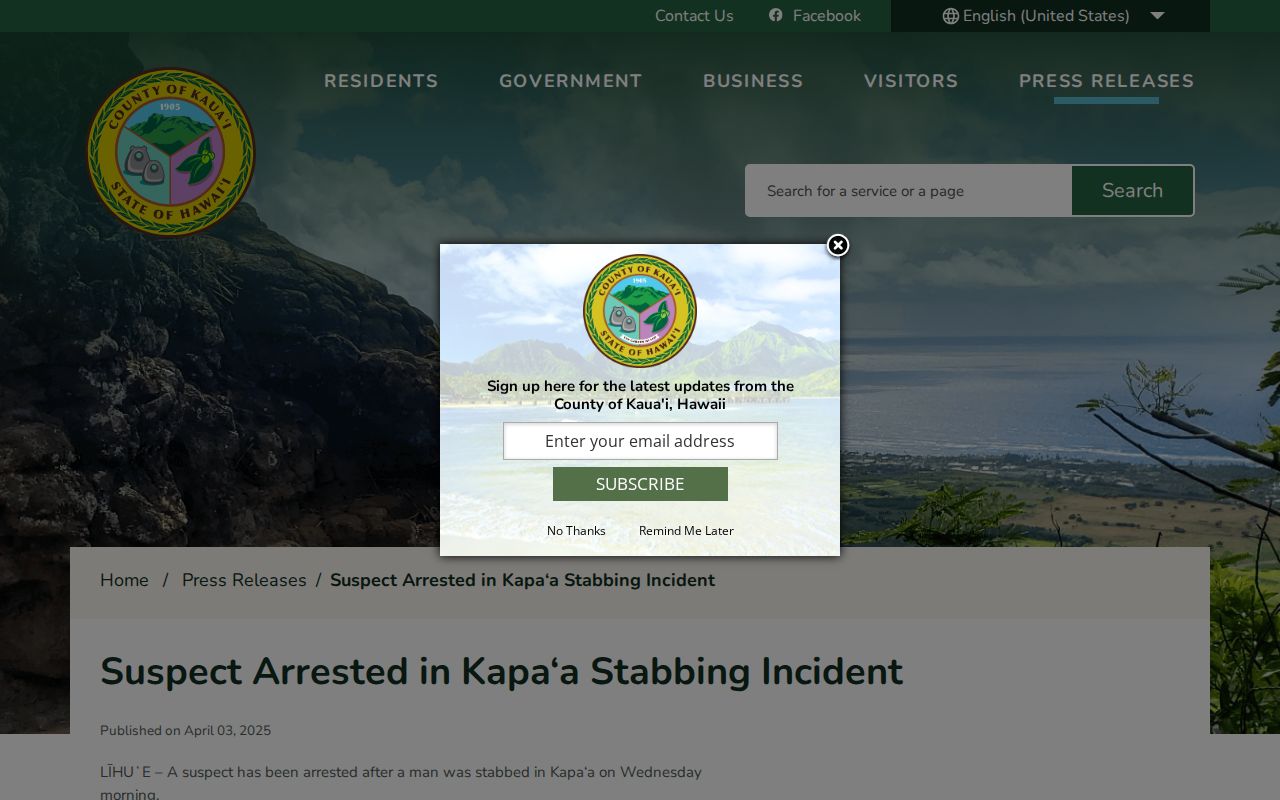
Court disposition, not the image, tells what happened after the arrest.
Kapaʻa Busted News Is Islandwide
The Garden Island, Kauaʻi Now, and Hawaiʻi News Now all treat Kapaʻa as part of islandwide coverage. A story might name a local street, an operation, or an arrest date. But none of them runs a Kapaʻa booking feed. When a story is your first lead, begin with the county news landscape and trace the article back to KPD and the court.
Mugshots.com lists Kapaa under its Kauaʻi category. That category sits empty. RecentlyBooked has no verified Kauaʻi section, and no genuine Kapaʻa page exists for Busted Newspaper or Mugshots Zone. Treat any unofficial page as suspect. It can be stale or flat wrong, and it is never a county roster.
Coverage may draw on a KPD image, surveillance footage, or a news photograph. Read the captions and the dates carefully before drawing conclusions.
KCCC After a Kapaʻa Bust
Who runs the jail? Not Kapaʻa. The state does. The Hawaiʻi Department of Corrections and Rehabilitation operates KCCC, and no county sheriff or town agency has a hand in it. If an inmate listing shows an `ISC` code after a court appearance, that typically points to a transfer through the Intake Service Center and on to KCCC. Two state tools are worth knowing here. DCR's KCCC page covers the facility itself, and Hawaiʻi SAVIN/VINELink sends custody and parole notifications. Neither one posts Kapaʻa booking photos on a regular schedule, so treat them as custody tools rather than mugshot sources.
Where a person sits changes which agency can answer your question. Someone released by KPD still has an arrest record. Someone moved to KCCC may no longer appear in a KPD cellblock answer at all. A prison sentence or a federal transfer sends you to yet another office. Figure out the custody status first, then pick the agency.
Kapaʻa Charges Need a Disposition
Kauaʻi cases move through the Fifth Circuit. The Judiciary's Search Court Records page connects you to eCourt Kōkua, though the online display skips some files. When the screen comes up empty, call instead. Circuit Court can be reached at (808) 482-2300, and the District Court criminal or misdemeanor clerk answers at (808) 482-2645.
An arrest entry tells you one thing. Police reported a bust. Charges can shrink, vanish, or get declined outright, so the booking log is never the whole story. The court file carries the rest.
The court record is where the case actually lives. Start there after the KPD PDF and the photo-bearing release. An online search that returns nothing does not mean the arrest never happened. Ask the clerk for the right Fifth Circuit format instead.
Kapaʻa Is Not the Arrest Filter
That Residence City column can trick you. It reflects whatever home address the agency listed, nothing more. It says nothing about where the incident took place, where the booking happened, or whether it fell inside the Kapaʻa CDP line. A Kapaʻa resident can get arrested on the far side of the island. Someone booked in Kapaʻa can claim another town entirely.
For a local question, stack the report date, the incident description, and the KPD release together. The KPD Crime Mapping page adds useful incident and trend context. A map dot is not a booking result, though. It cannot replace the arrest log, custody record, photo request, or court case.
Older Kapaʻa Busted Records Need KPD
KPD's online index shifts constantly. New daily PDFs push older ones out of view, links move, corrections happen, and some entries simply stop being published. None of that means the arrest or photograph was destroyed. And a search engine cache is not an archive, so don't lean on one as your record source.
A written request to KPD Records works best when it's narrow. Give the name, the date range, and the Kapaʻa incident if you know it. Request three things separately: the daily media arrest report, the underlying arrest or booking record, and any releasable booking photograph. Court case? File a separate Fifth Circuit request. DCR custody? Name KCCC and ask DCR which record category applies. Splitting the requests keeps an old local story from posing as a complete police file.
For deeper history, the Hawaiʻi State Archives records-management material is the place to look. KPD has never published a booking-photo retention period, so old photos may still exist even after they leave the web index.
From Kapaʻa Busted Arrest to Court
One Kapaʻa arrest, several separate records, and no single source that shows the whole path. KPD logs the arrest and the release code. KCCC or another DCR facility may log later custody. The Fifth Circuit holds the arraignment, bail, charging changes, plea, dismissal, trial, or sentence when the case is public. A news story usually captures only step one.
Follow the chain in order: arrest date, KPD charge, release code, custody handoff, court outcome. The codes matter. `RPI` means release pending further investigation, which is not a promise of charges. `RNC` and `RPC` can mean charges were never filed or prosecution declined. `ISC` marks the KCCC handoff after court. Each one describes a step in the process and nothing more.
That's why a photo or news clip should always be read next to the official KPD and Judiciary sources. A later dismissal or expungement changes the legal record, even when the old article still sits in a news archive.