
Kauaʻi County Busted Mugshots Explained
What is a mugshot? It is the photo taken when someone is booked after an arrest in Kauaʻi. The booking record wraps context around that image. Expect a name, the date and time, the reported charge, and notes from the arresting agency. For ordinary island cases, that agency is the Kauaʻi Police Department, known as KPD. Kapaʻa, Līhuʻe, and Wailua Homesteads have no police force of their own. There is no county sheriff posting a public booking gallery either. Hawaiʻi's statewide Sheriff Division handles court security, transport, and process service, but it does not run the island's arrest log.
Custody status tells its own story. A detainee usually starts at the KPD Cell Block or Intake and Detention. After a court appearance, the release code `ISC` signals a transfer to the State of Hawaiʻi Department of Corrections and Rehabilitation, most often at Kauaʻi Community Correctional Center. Someone released can vanish from a live custody lookup. Yet the arrest report, the court case, and any obtainable booking photo all remain. A sentenced person may shift into a DCR prison. Federal or immigration detainees sit in separate systems. Charges can shrink, get dropped, or resolve another way, which is why the court disposition matters so much.
What a Kauaʻi Busted Booking Record Shows
The public KPD daily Media Arrest Report is not a full booking packet. It shows a narrower set of fields. It also leans on release-disposition codes. One person can appear in several rows when several charges are reported. There is a Residence City field. But it does not prove where the arrest happened, and it does not follow Census place boundaries.
The complete record may be split across KPD, the courts, and DCR. Ask for the exact item you need rather than hoping one PDF holds everything. Here is the public report's field inventory:
| Field | What the public source shows |
|---|---|
| Arrestee name | Adult names appear in the daily report. Juvenile and protected matters follow different privacy rules. |
| Residence city | A reported residence city appears in the sample, but it is not the arrest location. |
| Arrest date and time | The report gives an “Arrest Date Time” field and is organized by arrest date. |
| Sex and age | Both fields appear in the sample. They should not be used to reconstruct a protected juvenile record. |
| Charge | The charge recorded at arrest. Several rows may belong to one arrest. |
| Release disposition | Codes such as RBL, ROR, RPI, RNC, RPC, DCT, CCT, FCT, TOT, PVC, and ISC mark a process stage. |
| Booking number | Not shown in the sampled daily media PDF. Ask KPD Records for the underlying record. |
| Photo, bond, facility, court date | Not routine fields in the sampled PDF. A selected press release may show a photo or bail detail, while court and custody offices hold later information. |
The codes read like shorthand. `RNC` means KPD reported no charge or no formal charges filed. `RPC` signals prosecution declined. `RPI` marks release pending further investigation, and `ROR` means release on recognizance. The codes `DCT`, `CCT`, and `FCT` point to court processing rather than any outcome. `ISC` flags the KCCC transfer after court. Each term helps decode a record.
Why Kauaʻi Busted Photos May Be Missing
The KPD arrest log is a dated PDF feed. The sampled report carries no photo column or routine photo link. That does not mean no mugshot was ever taken. KPD press releases show a selective habit instead. A Līhuʻe warrant-sweep release labels several images as mugshots. Certain Kapaʻa and Wailua releases attach a booking photo to a public-safety or case announcement. These incident-driven releases fall well short of a full roster.
The official KPD Arrest Log interface makes the split plain. A text report is one thing, a photo-bearing release another. The capture below links to that live log rather than to any unofficial image collection.
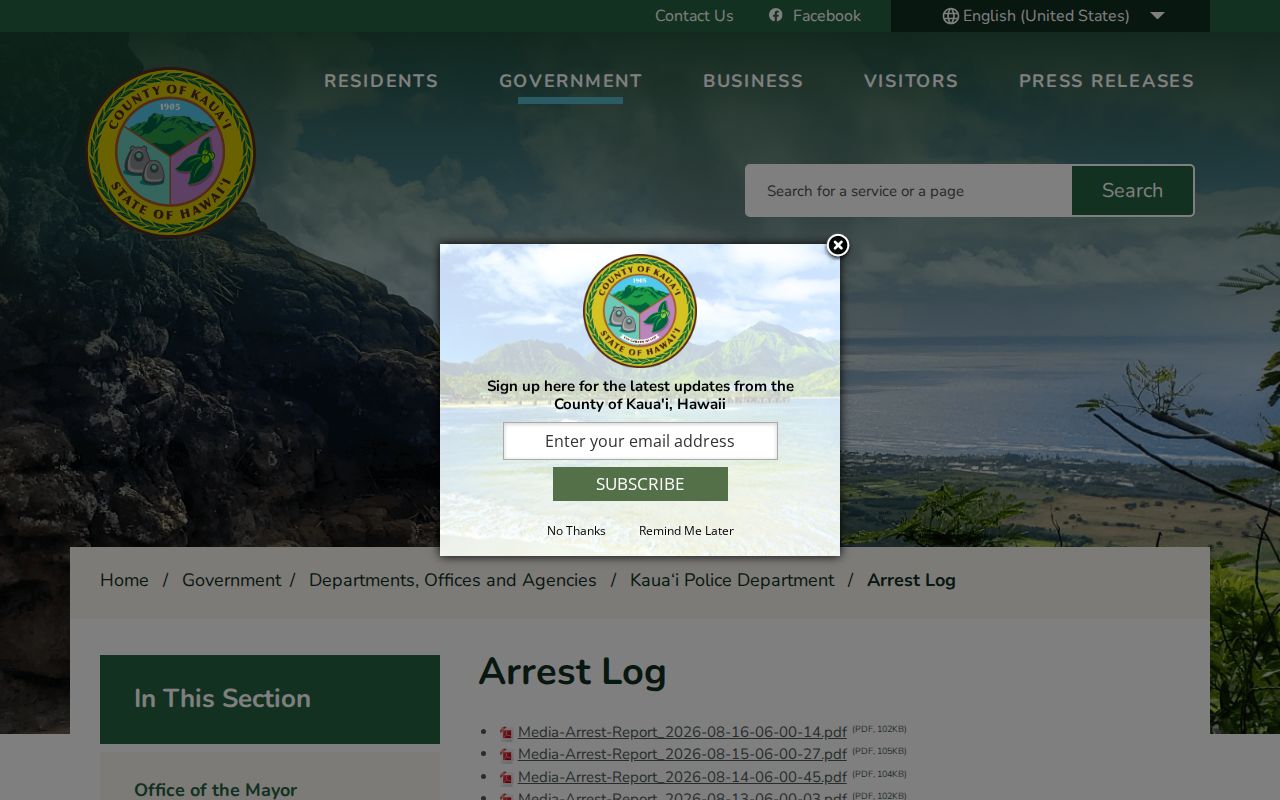
The report can prove that KPD published an arrest entry on a given date. It cannot answer a current custody question. It cannot settle a final disposition or hand you a routine mugshot. For a specific photo, follow the targeted KPD Records path below.
Request a Kauaʻi Busted Record or Photo
KPD Records is the place to start for an arrest report, a booking record, or a releasable booking photograph. Per the KPD Records Section, requests are reviewed under Hawaiʻi's Uniform Information Practices Act. Most reports become releasable once investigations close. The department asks for 48 hours to respond. That is only an initial expectation, though. A complex file or photograph may take longer. The current page lists no fixed booking-photo fee.
The electronic KPD non-business request form wants your full name, mailing address, phone number, a report number if you have one, the report type, the incident date, and a copy of a driver's license or state ID. Staff schedule a pickup appointment once a report is ready. Ask whether electronic delivery is possible. Have Records confirm any copy, media, redaction, or delivery charge first.
- Identify the person, approximate arrest date, report number if known, and the exact record requested.
- Submit the non-business form or another written KPD/UIPA request. Request the daily arrest entry, the underlying arrest or booking record, and any releasable booking photograph as separate items.
- State a preferred delivery method and ask KPD Records to identify withheld material, redactions, or fees.
- Keep the request and response. If the record is older, ask whether the web PDF rolled off, whether another custodian holds it, and what retention authority applies.
KPD Records Contact
Kauaʻi Police Department
3990 Kaʻana Street, Suite 200
Lihue, HI 96766
Records status: (808) 241-1929
Report-status email: kpdinsurance@kauai.gov
Headquarters: (808) 241-1900
Copies can arrive with redactions. Those may cover names, home addresses, Social Security numbers, birth dates, phone numbers, or other private details. If a request runs through statewide UIPA procedures, the Office of Information Practices request guidance lays out a general 10-business-day response or written acknowledgment, possible extra time, clarification steps, and prepayment rules. KPD's 48-hour language and OIP's statutory framework each cover different pieces of the process.
The KPD Records page remains the best source for the current request route. A just-booked question belongs with KPD Cell Block at (808) 241-1632 or Intake/Detention at (808) 241-1637. A DCR custody question belongs with KCCC or SAVIN. None of these contacts replaces a written records request.
The records page capture below shows the official request and redaction context. It displays no private submission.
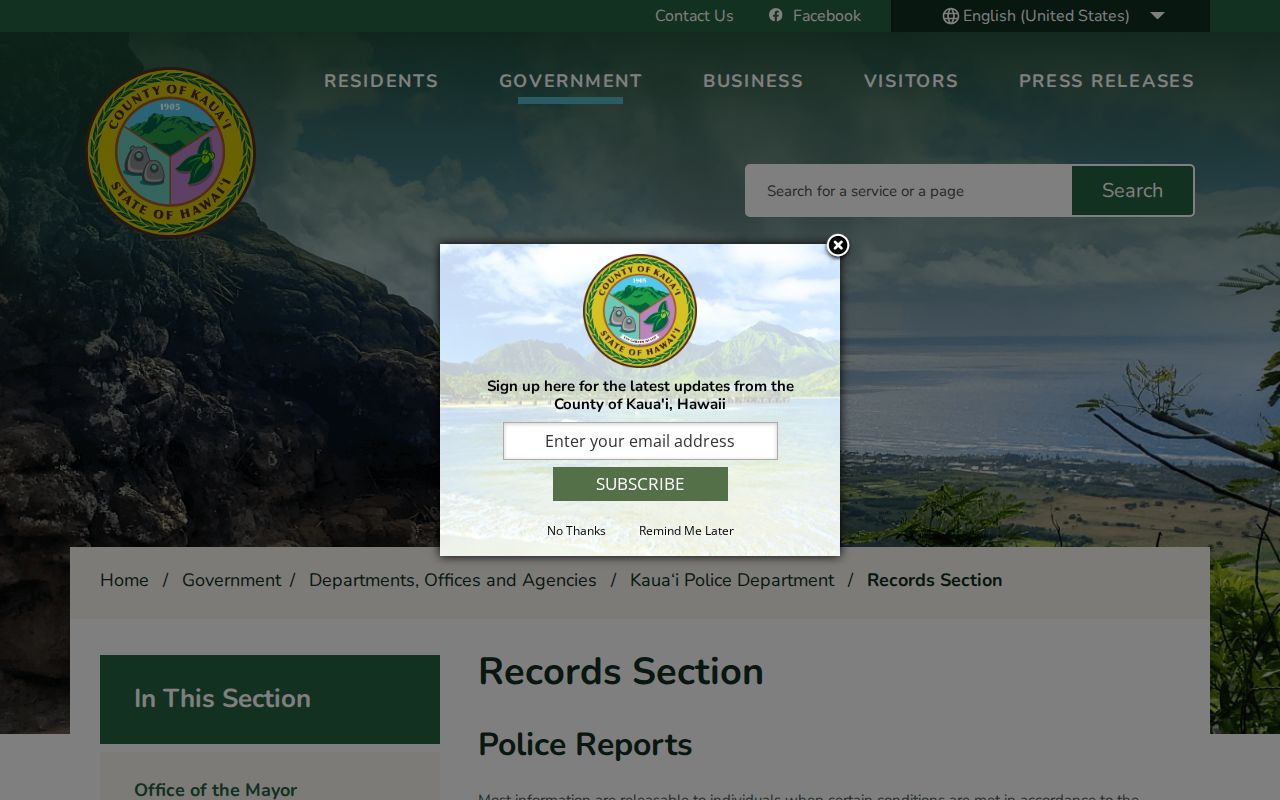
A photo request should name the arrest and ask for any releasable image. UIPA access cannot override juvenile confidentiality, an active-investigation restriction, a court order, expungement, or any other exception.
Hawaiʻi Mugshot Access and Removal Law
Hawaiʻi's open-records law is the UIPA, found in HRS chapter 92F. Its default is disclosure. Under HRS §92F-11, government records are presumed public unless a restriction applies. The exceptions sit in HRS §92F-13: privacy invasions, protected prosecution material, legitimate government functions, other statutes, and court orders. Where do booking photos fit? OIP Opinion 94-12 treats county police booking photographs as public records under UIPA. Each request still turns on its own facts and any exception that attaches.
What about pay-to-remove? No Hawaiʻi statute targets mugshot sites. The HRS chapter 481B index shows nothing of the kind. SB 2631 from 2024 died as a proposal. So start any removal effort with the agency that holds the record and the site that published it. A demand for cash is not an official process. A removal vendor is not a shortcut either.
Fixing a Kauaʻi record means picking the right lane. A wrong KPD entry goes to KPD Records for review of the exact error. A qualifying nonconviction arrest can go the expungement route under HRS §831-3.2, which even lets a person ask for the return of fingerprints or photographs tied to the arrest, subject to the statute's exceptions. The HCJDC expungements page lays out the process. Expect about 120 days. Fees run $35 for a first request, $50 for a later one, and $20 for a duplicate certificate. The June 2026 application asks for identification, a signed form, a stamped envelope, and payment, and eligible orders get forwarded to the Judiciary. One deferred-acceptance waiting-period detail differs between the webpage and the application form, so confirm it with HCJDC or an attorney.
Expungement has limits. A state order does not wipe out independent news archives or copied web results on its own. Get the official order first. Then have KPD or whichever custodian holds the record correct it at the source. After that, use the publisher's free correction channel if one exists. Turn to Google's outdated-content troubleshooter or Bing's removal tool once the underlying page has changed or vanished. The capture below serves as a policy and process reference, not a gallery.
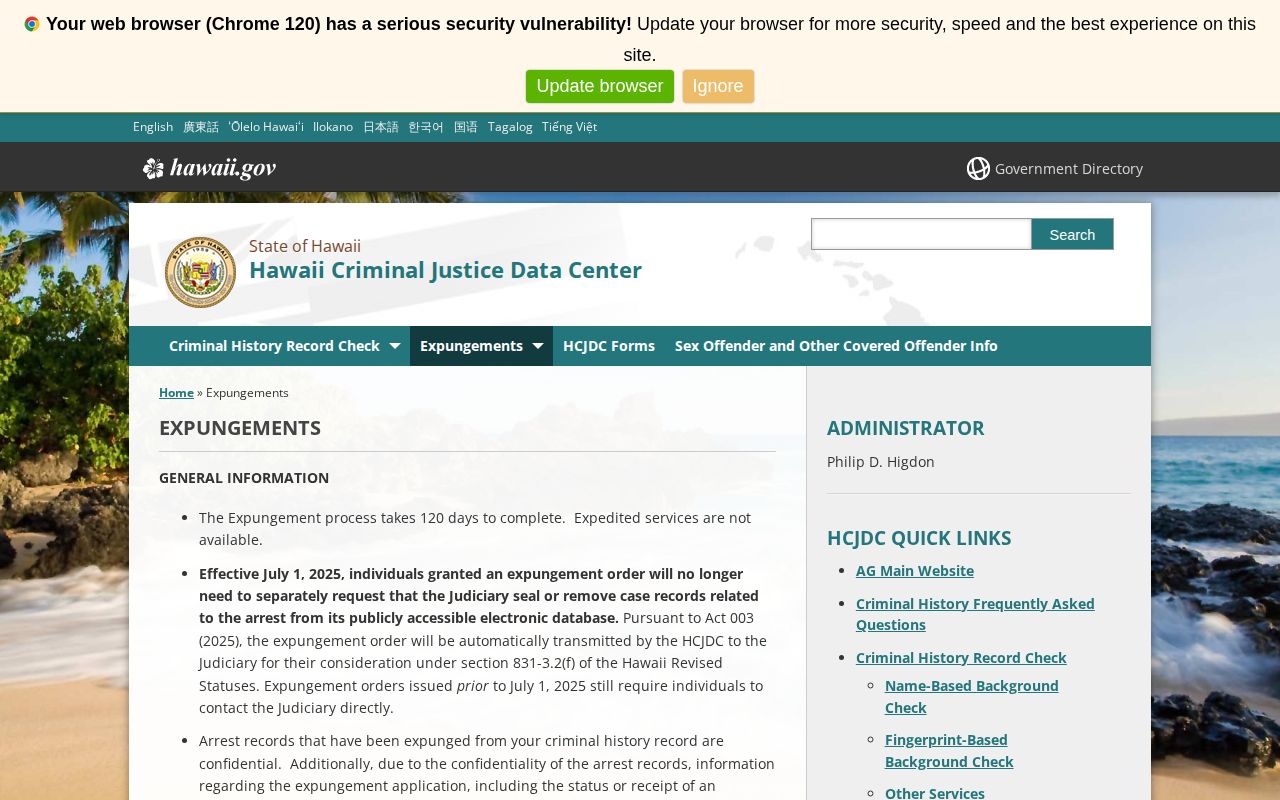
Juveniles get a higher wall. HRS §571-84 shields juvenile court and police records. It also restricts how a minor's photograph or fingerprints circulate. A missing juvenile name or image is a privacy protection working as intended, not a gap to fill from some unofficial source.
Why Old Kauaʻi Busted Arrest PDFs Disappear
The KPD Arrest Log runs on rolling daily PDFs. The index typically holds about a month of reports at a time, though the department never calls that a formal retention schedule. Links vanish for mundane reasons. The window rolled forward, a file shifted, a correction was issued, or the publication practice changed. A dead link proves nothing about the underlying arrest, booking, report, or photograph.
Chasing an older entry? Ask KPD Records for each piece separately: the dated media arrest report, the full arrest or incident report if releasable, the booking record, and any photograph the department can release. Court material belongs to the Fifth Circuit. DCR custody questions go to DCR. The Hawaiʻi State Archives records-management source explains state schedules and transfers, but no public KPD-specific booking-photo retention period exists, so never graft a state schedule onto a county police request.
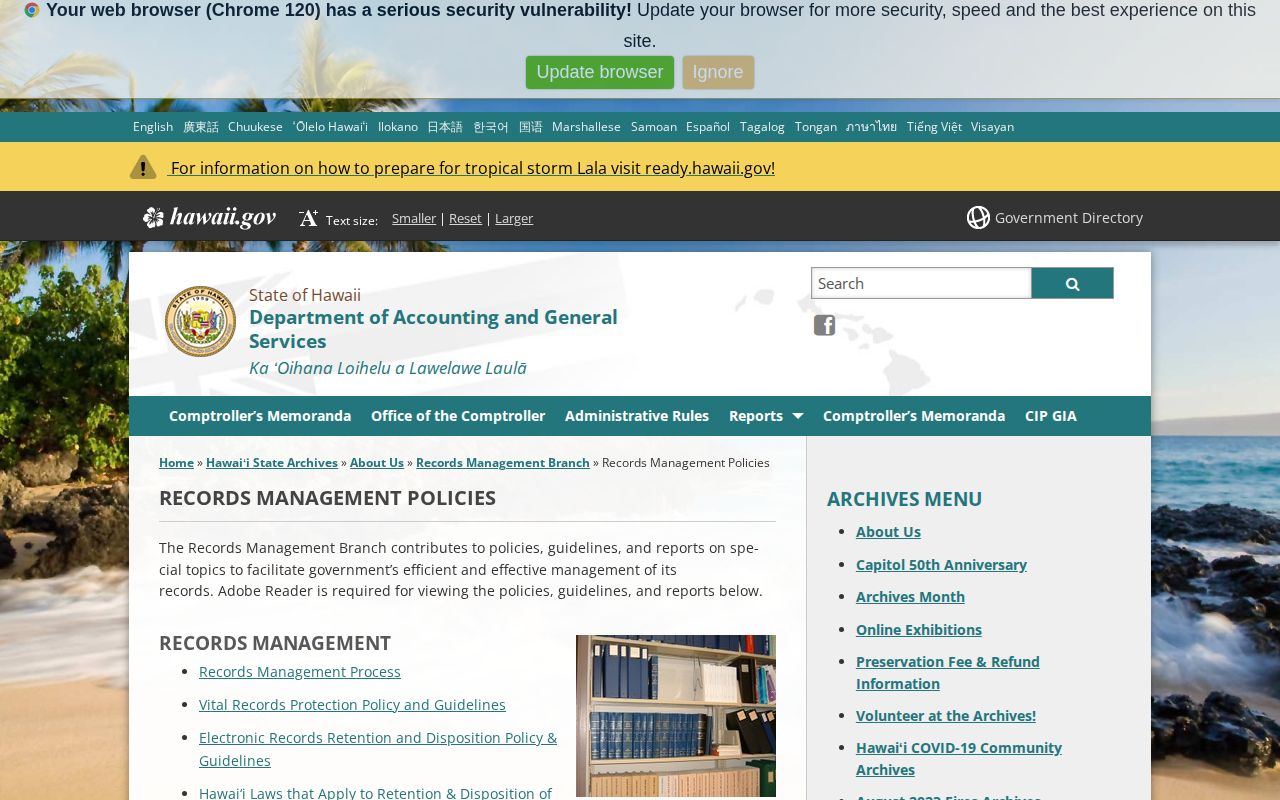
The archive image illustrates the records framework, not a searchable modern Kauaʻi mugshot collection. Keep the report date, source URL, and request response handy when pursuing an older record.
How to Find Kauaʻi County Busted Mugshots
Kauaʻi has no single search box that spans every custody setting. You have to match the source to the situation. A recent adult arrest starts with the official KPD Arrest Log, though someone booked moments ago may still sit in the police cellblock and miss the next PDF. A DCR detainee shows up through SAVIN/VINELink. Final outcomes live in eCourt Kōkua. Federal and immigration matters run through their own locators.
- Open the KPD Arrest Log for the relevant report date and search the PDF for the name. Read the entire row, charge, arrest time, and release code.
- If the arrest is too new for the PDF, use KPD’s official Cell Block or Intake/Detention contact for a current custody question. A phone inquiry is not a public roster.
- For a photo, check a matching official KPD press release, then submit a KPD Records/UIPA request for the releasable booking photograph.
- If the person moved after court, check DCR Hawaiʻi SAVIN/VINELink. It handles DCR custody and parole notifications, not a pre-court KPD hold.
- Use Hawaiʻi Judiciary eCourt Kōkua and the Fifth Circuit clerk for the case and disposition. A public case search is not a definitive active-warrant check.
- Use BOP or ICE only when the person’s custody belongs to those federal systems. Do not treat a missing result in one system as proof of release.
These routes describe source routing, not a photo gallery. The correct answer may well be a text arrest record, a records-request response, a custody alert, or a court file rather than an image.
Is There a Kauaʻi Busted Jail Roster?
No verified KPD or KCCC public roster exists. Neither agency posts a current-custody table with names, booking numbers, search fields, and photographs. KPD does publish phone contacts for Cell Block and Intake/Detention. The KCCC facility page describes the State DCR jail, its programs, and contact details, but it is no live inmate roster. Hawaiʻi SAVIN/VINELink sends status notifications once DCR custody is established, not images.
That negative result has value. It keeps an unofficial "inmate roster" from masquerading as a county source, and it stops a phone call to KPD from being mistaken for an open database. The practical roster workflow follows:
- For a just-booked person, call KPD Cell Block at (808) 241-1632 or Intake/Detention at (808) 241-1637 through the official KPD contact route.
- For a dated public arrest entry, use the KPD PDF and its release-code legend.
- For post-court DCR custody, use SAVIN/VINELink or the KCCC contact. Expect status information, not a mugshot gallery.
- For a photograph or older record, make a targeted KPD Records/UIPA request.
KPD does not publish a public roster with booking numbers, bond amounts, facility assignments, or routine booking photos. Expect none of those fields. A person can also move fast. Someone may leave the cellblock, transfer to KCCC, get released, or wind up with another agency while the arrest record itself stays available through records channels.
The KCCC reference ties back to the official DCR facility page. That page gives facility context, not faces.
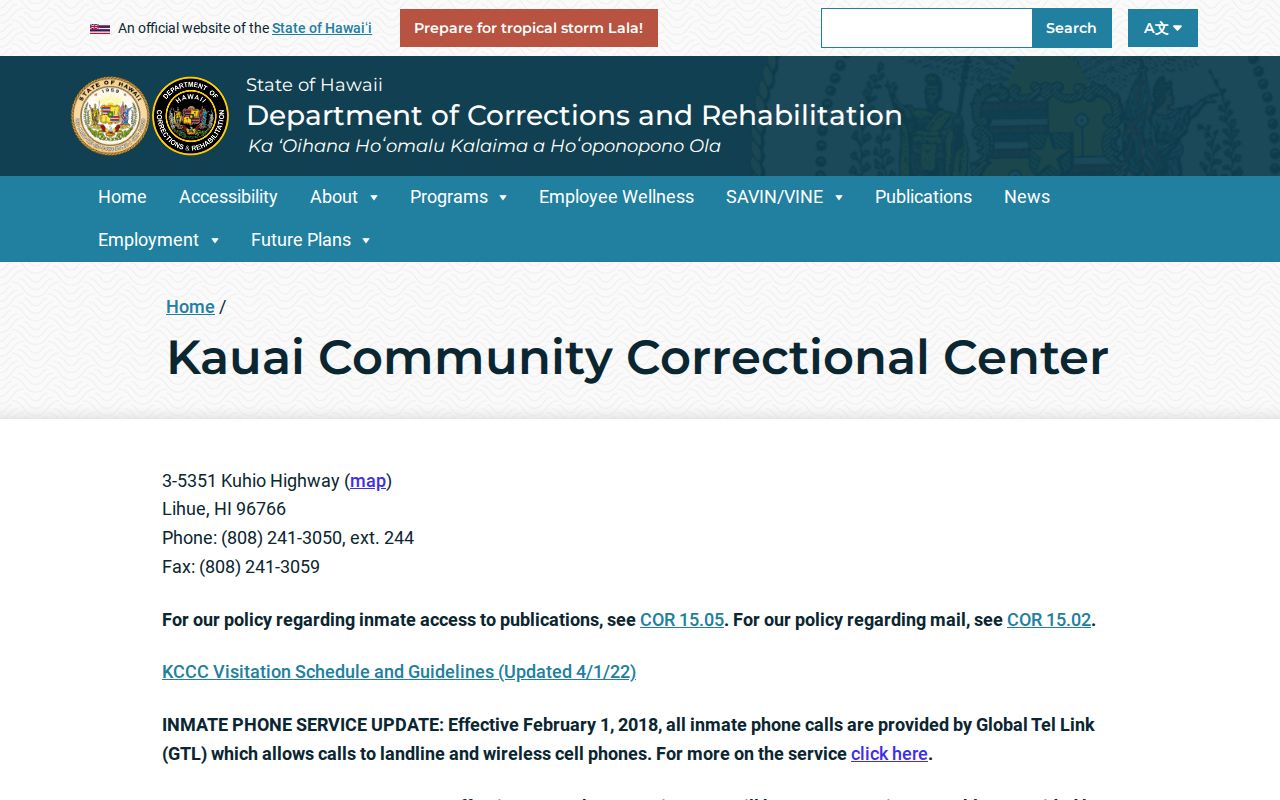
KCCC is a state jail run by the DCR. No county sheriff roster attaches to it. A facility page can't tell you where every person who passed through KPD stands right now. Treat it as one piece of the picture, not the whole thing.
Busted Last Night: KPD Arrest Log Windows
KPD posts no official same-day booking table. There is no round-the-clock photo feed either. What exists is the KPD Media Arrest Report. It's a dated PDF printed close to 6:00 a.m., and it generally covers the prior date. Anyone busted after the print time likely waits for the next report. For urgent custody questions, call KPD Cell Block, Intake/Detention, or Dispatch rather than relying on a third-party page.
For a wider view, use the KPD Arrest Log index. It posts one PDF per report date, not a combined weekly table. Fields include Residence City, Arrestee Name, Arrest Date Time, Sex, Age, Charge, and Release Disposition. The public window spans roughly the most recent month, though the dates shift. KPD promises no fixed weekend surge. There is no set posting deadline and no set web-retention period.
| Question | Best source and limit |
|---|---|
| Booked today? | No verified public same-day table. Contact KPD through the official live-stage numbers. |
| Recent adult arrest? | Use the daily KPD PDF for the date and read the release code. |
| Routine booking photo? | Not in the sampled PDF. Check a selected KPD release or request the photo. |
| Older than the web window? | Submit a focused KPD Records/UIPA request and ask about retention or transfer. |
Think of the KPD arrest log as a chronology, not a live custody answer. The codes matter. `RBL` means release after bail or bond, `ROR` release on recognizance, `RPI` release pending investigation, and `TOT` transfer to another agency. `ISC` points to KCCC after court. Read the code beside the name. A PDF hit does not mean the person is still sitting in jail.
Kauaʻi Apps Are Not Booking Feeds
Kauaʻi has several apps and alert systems. None is a booking feed. DCR Hawaiʻi SAVIN routes to VINELink for custody and parole notifications by phone, text, email, or app. It skips people still held in a KPD cellblock and posts no booking photographs. The Crime Stoppers Kauaʻi P3 Tips app handles anonymous tips. ALERT Kauaʻi and Everbridge push emergency and life-safety alerts. None works as a daily arrest or mugshot subscription.
KPD's main page and news channels can surface a wanted-person photo or a chosen arrest release. Its Crime Mapping page points to CityProtect for incident trends. That map carries no names, custody details, booking photos, or court outcomes.
Match the tool to the need. Everbridge will never produce a jail roster. Tips go through the official tip route. A photograph should never be used to confront anyone. For DCR custody tracking, SAVIN/VINELink is the right channel, though a notification is not a mugshot result.
Hawaiʻi DCR Custody and Photos
The State of Hawaiʻi Department of Corrections and Rehabilitation runs KCCC and other state jails. Those jails sit apart from state prisons. KCCC holds people before trial plus certain short-term and transitional-sentence groups. Once someone is sentenced and moved to a state prison, a KPD cellblock inquiry stops reflecting them. The official DCR Hawaiʻi SAVIN page links to VINELink for custody and parole status.
SAVIN accepts offender information for searches. You can also register a PIN for alerts. The DCR page lists a KCCC SAVIN contact at (808) 241-3057. Facility materials give (808) 241-3050 as the general line. Both answer status and facility questions, never photo searches. Hawaiʻi has no official DOC offender-photo portal for Kauaʻi arrestees. An unofficial roster should not be treated as a stand-in.
DCR covers the DCR custody state only. Someone at KPD before court may simply not appear there. So might someone released, someone in federal prison, or someone held by ICE.
Booked, Released, or Busted at KCCC?
"Not on the roster" can mean several things at once. The right source depends on where the person sits in the custody process, and a current status result never erases the arrest record itself.
| Custody state | Where to look | What may remain |
|---|---|---|
| Just booked at KPD | KPD Cell Block or Intake/Detention; next KPD PDF when posted | Arrest entry, charges as booked, later requestable records |
| At court or transferred to KCCC | KPD release code, KCCC contact, DCR SAVIN/VINELink | KPD arrest record and a court case may continue |
| Released | KPD arrest log, KPD Records, Judiciary | Historical booking record or photo may remain obtainable |
| State-sentenced custody | DCR and SAVIN/VINELink | State custody status, court disposition, agency records |
| Federal or immigration custody | BOP, ICE ODLS, or the relevant federal agency | Separate federal or civil-custody records, not a KPD roster |
After the Bust: Kauaʻi Court Dispositions
An arrest is only the first paper in a case file. To see how things ended up, use the Hawaiʻi Judiciary's Search Court Records page. It points you to eCourt Kōkua. That system covers traffic, District Court, Circuit Court, Family Court adult criminal, civil, and appellate matters. Not every record shows up online, though. Kauaʻi cases live in the Fifth Circuit at Puʻuhonua Kaulike, 3970 Kaʻana Street, Līhuʻe. Call the Circuit Court at (808) 482-2300. The District Court criminal and misdemeanor clerk sits at (808) 482-2645.
A charge can shift fast after booking day. Prosecutors may drop it, swap it, or amend the complaint. Judges set bail, grant release, dismiss, take a plea, or hold a trial. The daily KPD charge is a starting point. The disposition tells you how the story actually ended. Want hard copies? The eCourt guide prices them at $3 for one through 30 pages, then $0.10 per page after that.
Juveniles get extra protection under HRS §571-84. If a minor's name or photo is missing, leave it that way rather than piecing it together from news stories or third-party sites. The official Judiciary capture below maps out the disposition route.
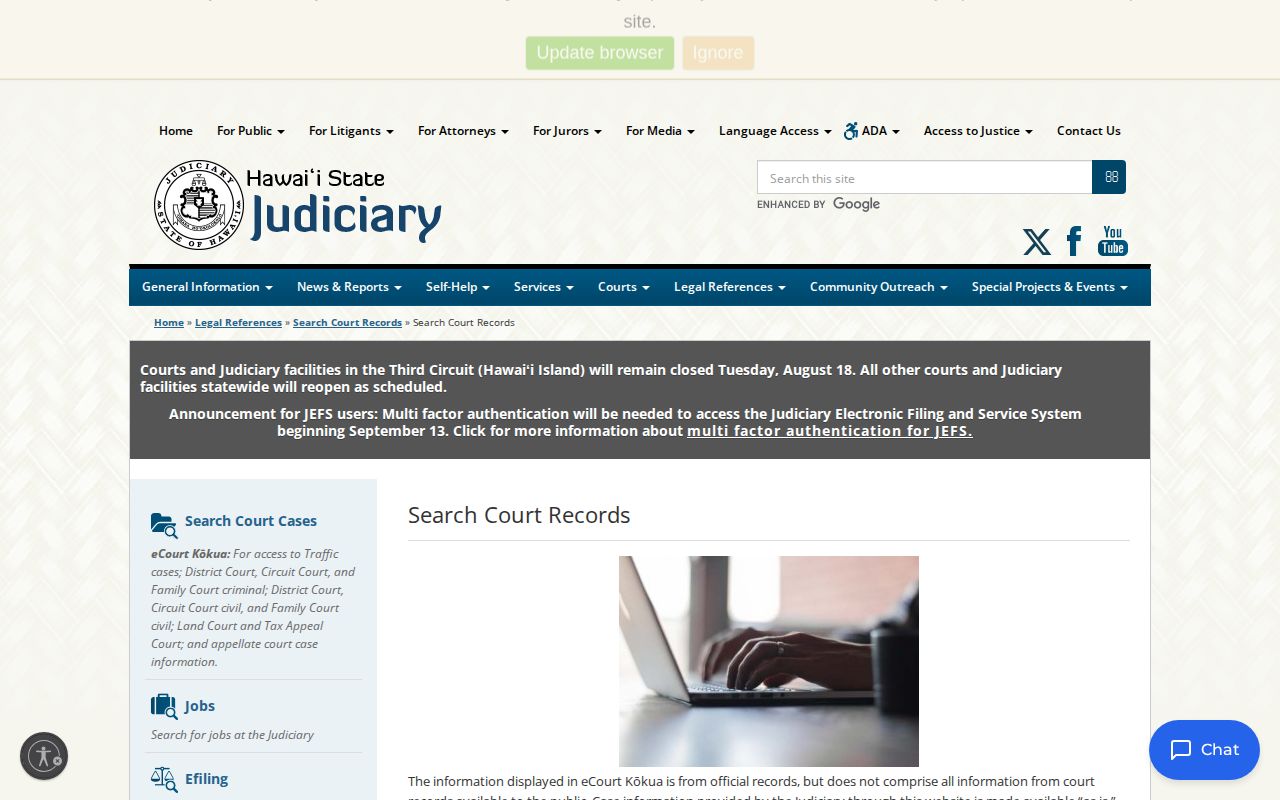
Hit a dead end with an online search? Call the Fifth Circuit clerk. The staff can confirm the right case number format or pull a non-confidential document for you. One more thing worth knowing. A name search that returns nothing only means the search failed. It does not mean the arrest never happened.
Federal and Immigration Custody
Federal custody works differently. The right tool depends on the agency holding the person. The Federal Bureau of Prisons locator reaches back to 1982 and lists anyone who has served federal time. Read the results with care. A status of "Released" or "Not in BOP Custody" does not rule out state, local, or supervised custody elsewhere. The locator tracks status only. There is no public booking-photo gallery, and a KPD arrest alone will not generate a BOP entry.
For immigration detention, use ICE's Online Detainee Locator System. It demands exact identifiers. It has gaps for minors and for very recent or unlisted custody. The Marshals Service is quieter still. It states plainly that it releases no public information or photographs of federal prisoners. For any federal matter, work through the holding agency, an attorney, or a family contact rather than these public tools alone.
Busted Mugshots by Kauaʻi City
Kauaʻi has no true cities. The Census Bureau recognizes no incorporated places in Hawaiʻi at all. So the city pages here lean on the three largest census-designated places from the 2020 Census table instead. Each page sketches the local geography. Every arrest record routes back to countywide KPD systems. One caution applies. A Residence City field tells you where someone lives, not where the bust happened.
- Kapaʻa Busted Mugshots: the largest selected population center, with KPD releases about a stabbing and vehicle break-ins.
- Līhuʻe Busted Mugshots: county seat and courthouse hub, with a KPD warrant-sweep release showing selective mugshot publication.
- Wailua Homesteads Busted Mugshots: an east-side CDP covered by countywide KPD reports and Wailua public-safety releases.
All three pages follow the same custody trail. KPD Cell Block or Intake comes first. Then KCCC follows a court transfer when the path calls for it. For a report or any releasable photograph, the route is always the same: KPD Records.
Kauaʻi News and Busted Third-Party Results
Start with the primary sources. KPD releases, the daily arrest PDF, KPD Records, DCR, and the Judiciary all outrank the press. Local news fills in color and circumstance. The Garden Island, Kauaʻi Now, and Hawaiʻi News Now's Kauaʻi section run arrest, warrant, and court stories on no fixed schedule. Photos in those stories may come from KPD, from surveillance footage, or from the paper's own files. A story also lingers in the archive long after the court record moves on.
Third-party mugshot sites deserve a skeptical eye. Mugshots.com's Kauaʻi category exists as a real county page. It showed "This category is empty" when viewed. The site names places like Kapaa and Lihue, yet that emptiness proves nothing about what KPD holds. Its own policies allow free updates or removal in some situations. RecentlyBooked's Hawaiʻi directory listed Honolulu but no verified Kauaʻi page, and its correction policy has no local Kauaʻi URL to work with. Busted Newspaper offered no genuine Hawaiʻi section. Mugshots Zone resolved to nothing verifiable.
Never treat an SEO funnel or a guessed URL as a roster. If a third-party page later posts a Kauaʻi entry, check the source, the date, and whether corrections are free. Do not copy or rehost a booking photo. An unofficial result is never a custody answer.
Note: The secondary-source capture below serves only as a landscape reference for the county category.
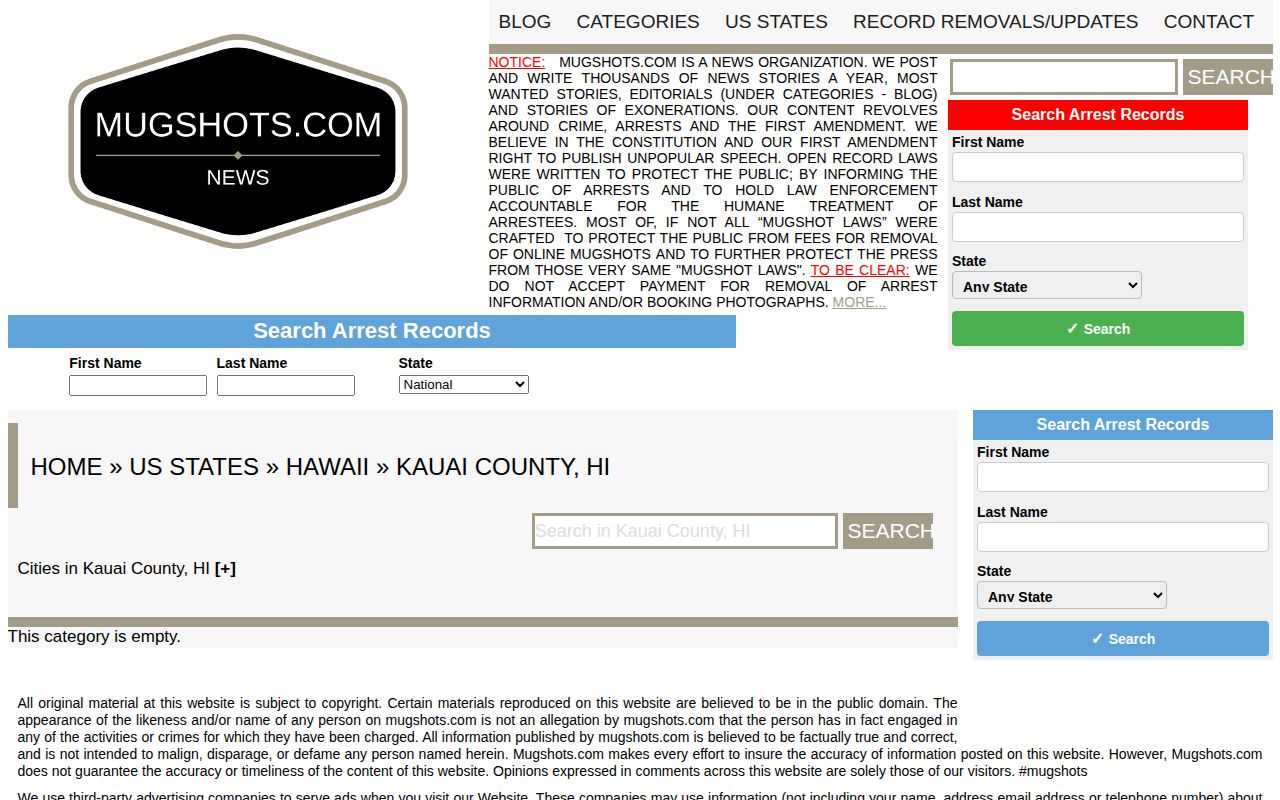
A third-party category can sit empty, go stale, miss cases, or carry the wrong county label. The KPD record and the later court disposition remain the paths that actually control.
Why a Kauaʻi Arrest Moves to KCCC
KPD's `ISC` release code has a plain meaning. It marks the handoff from police processing to the Intake Service Center, then, after court, to KCCC. One letter explains a lot. A person can drop off a KPD cellblock inquiry while still in custody down the road. It also explains why a KPD arrest report and a DCR custody notification answer different questions entirely.
KCCC belongs to State DCR. It holds pretrial, short-term, and transitional populations. Treat the code as a process marker and nothing more. Once the person's path reaches that system, check DCR custody. The court record settles the legal outcome.
Kauaʻi Arrest Statistics Need Context
Numbers help, but only with the right frame. KPD's FY 2023–2024 annual report counts 3,109 total arrests: 2,725 adults and 384 juveniles, plus 3,740 total charges. That is one fiscal year's statistics. It is not a live count, a city ranking, or a tally of rows in any single daily PDF.
Annual figures give agency context. The dated arrest log gives the individual record. Keep the two separate.
Reading KPD Release Codes After a Bust
KPD's code legend opens a window onto the after-booking stage that many agencies keep closed. Release and prosecution status shows up in `RPI`, `RNC`, `RPC`, and `ROR`. Court routing appears as `DCT`, `CCT`, or `FCT`. An `ISC` code flags a KCCC transfer. Read the whole row before drawing anything from it. Then take the case number to eCourt Kōkua for what came later. Treat every code as a dated process snapshot.
Why Juvenile Kauaʻi Records Are Absent
HRS §571-84 shields juvenile court and police records from public view. Access is limited to authorized uses, and the law also restricts circulation of a minor's photograph or fingerprints. So when a child's name or image is missing, that silence means something. It is the law at work. Do not try to rebuild a protected booking from social media posts, a third-party result, or a partial report.
Public Court Search Is Not a Warrant Check
Two systems, two jobs. eCourt Kōkua opens case information to the public, while eBench Warrant stays locked behind login for approved law-enforcement and criminal-justice users. A public case search can help you find a disposition. It cannot confirm an active warrant. For that line between warrants and safety, see the Sheriff's Most Wanted page.
KCCC Is a State Jail, Not a County Roster
Kauaʻi Community Correctional Center sits in an odd spot for record hunters. It answers to the state Department of Corrections and Rehabilitation, not the county. It holds people after court action and serves populations the state defines. That means the county sheriff never runs a booking roster from this facility. Its public page posts no routine mugshots either.
So split your search in two. An old KPD arrest record stays a KPD records question. Current custody at KCCC goes through DCR, with SAVIN as the notification tool.